From just about every technical standpoint, The Artist is a masterpiece; really it has to be, as it needs to hold the attention of a 21st century audience with the film making techniques of nearly a century ago and absent of any spoken dialogue or color. A great, consistently moving score help to keep you engaged with a plot that could easily lose you otherwise. Meticulous cinematography and art direction contribute as well. Michel Hazanavicius and his crew deserve tremendous credit for putting every aspect of a movie that might get glossed over because they're covered by strong acting under the microscope and making sure to get as close to perfection with them as they can. Even stuff I wouldn't normally notice like the snappy costumes stood out. And the performances are there to boot, as Jean Dujardin brims with the charm of a born leading man whose expressive physical work, comedic chops and ability to pour his heart into his face is remarkable. Berenice Bejo is a notch or two below Dujardin, but that doesn't mean she's not fantastic (she is). The supporting cast is wisely packed with actors not out of place in the setting who do so much storytelling with the way they move, particularly John Goodman, but also Missi Pyle and even James Cromwell; Penelope Ann Miller is a bit of a weak link, but she's not a particularly important cog. Finally the story being conveyed--the fall of a lovable but vain silent film star railing against talking pictures and his love story with the woman symbolizing his replacement--is strong with much to say. My big knock against The Artist would be its lack of staying power, meaning now that I've seen all the tricks (and there were some great ones, from everything I outlined to the gradual introduction of sound and so on), I really have no desire to watch it again. I'm also not sure how much my attention would have been held had I seen it in the theater as opposed to with my friends at their apartment, with us able to commentate over the whole thing (which we did). But hey, there are far worse things that being a darn near flawless piece of cinema that you only want to see once, and that dog was adorable.
Showing posts with label awards season. Show all posts
Sunday, February 26, 2012
Academy Award-Winning Paragraph Movie Review: The Artist
From just about every technical standpoint, The Artist is a masterpiece; really it has to be, as it needs to hold the attention of a 21st century audience with the film making techniques of nearly a century ago and absent of any spoken dialogue or color. A great, consistently moving score help to keep you engaged with a plot that could easily lose you otherwise. Meticulous cinematography and art direction contribute as well. Michel Hazanavicius and his crew deserve tremendous credit for putting every aspect of a movie that might get glossed over because they're covered by strong acting under the microscope and making sure to get as close to perfection with them as they can. Even stuff I wouldn't normally notice like the snappy costumes stood out. And the performances are there to boot, as Jean Dujardin brims with the charm of a born leading man whose expressive physical work, comedic chops and ability to pour his heart into his face is remarkable. Berenice Bejo is a notch or two below Dujardin, but that doesn't mean she's not fantastic (she is). The supporting cast is wisely packed with actors not out of place in the setting who do so much storytelling with the way they move, particularly John Goodman, but also Missi Pyle and even James Cromwell; Penelope Ann Miller is a bit of a weak link, but she's not a particularly important cog. Finally the story being conveyed--the fall of a lovable but vain silent film star railing against talking pictures and his love story with the woman symbolizing his replacement--is strong with much to say. My big knock against The Artist would be its lack of staying power, meaning now that I've seen all the tricks (and there were some great ones, from everything I outlined to the gradual introduction of sound and so on), I really have no desire to watch it again. I'm also not sure how much my attention would have been held had I seen it in the theater as opposed to with my friends at their apartment, with us able to commentate over the whole thing (which we did). But hey, there are far worse things that being a darn near flawless piece of cinema that you only want to see once, and that dog was adorable.
Labels:
awards season,
paragraph movie reviews
Tuesday, February 14, 2012
Paragraph Movie Reviews: Midnight in Paris
I'm not a guy who goes in for movies that are love letters to "insert city her," so I needed more from this one than pretty shots of Paris filling montages that go on a bit too long for my liking. I do like the particularity of Woody Allen's experienced-shooting style (which is still especially unique to me as I've only seen one other of his films), but again, not enough. The premise of a modern day romantic making his way back to 1920's Paris is a neat one, and novel because it brings about some excellent supporting performances in actors portraying real historical figures. Corey Stoll captures the screen with his intense Ernest Hemingway, Kathy Bates strikes a nice run-on sentence of a performance of Gertrude Stein, Adrien Brody has a fun cameo as Salvador Dali and I wanted to see more of Tom Hiddleston and Alison Pill's charming Fitzgeralds. The overall commentary Allen is making about everybody's romanticized past golden age being somebody else's dull present is one with mileage. Unfortunately all this stumbles for me with Owen Wilson's leading man performance, which starts awkward and only gets worse. I don't fault Wilson for playing out of his depth given that he's a man from the 21st century hobnobbing with his idols a century prior, but he goes too far with it and wrecks the flow of the piece for me. He has nice comedic bursts, his obvious strength, but a more meaningful dramatic performance is sacrificed and lacking. The most disappointing thing for me is how Wilson's googly-eyed rambling cuts so much of the cast's potential off because it kills the give and take. Rachel McAdams and Mimi Kennedy are brilliantly bitchy as the shallow fiancee and her loathsome mother, but Wilson fails to give his character, Gil, enough likability for me to really root against them. On the other side of the coin, Marion Cotillard is beguiling as the object of Gil's affection in the past, but the fact that she prefers this bumbler to the charismatic Hemingway when he displays no real affable qualities takes away from her credibility. It's rare that I like so much about a movie from its writing to its technical aspects to the general high quality of the performances and yet one actor can really spoil it for me, but Midnight in Paris is that unique exception.
Labels:
awards season,
paragraph movie reviews
Saturday, February 4, 2012
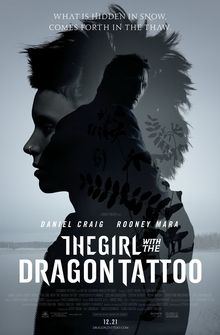
Paragraph Movie Reviews: The Girl With the Dragon Tattoo
I was in a different (though I'm sure hardly unique) position with this film, having read the book pretty recently and having the story fresh in my mind. Had that not been the case, I question how easily I would have been able to follow the dense mythology, as my wife had to ask me questions throughout and I was shocked at how quickly they glossed over some points that seemed so key to the novel. To be fair to David Fincher, Steven Zaillian and company, 700 pages of incredibly dense story is a lot to cram into even a two and a half hour frame, so obviously the cuts were both necessary and no doubt challenging. To their credit, I believe they do a great job maintaining the central mystery, which is at the heart of everything, and it plays out every bit as suspenseful and thrilling on screen as in the book, despite some judiciously subtracted elements. Where I do think the translation suffers is in building the characters, Mikael more so than Lisbeth, as so much of his background established in the early parts of the book is jettisoned (again, understandably to a degree) for time here and he becomes more of a pivot to get events moving rather than a fully realized player. Despite that, Daniel Craig does an excellent job bringing James Bond charm to the role, but also knowing when to pull back and make the character more human and vulnerable. Christopher Plummer is also standout as Henrik Vanger and anchors the slow-going first half hour or so with his tortured whimsy. Likewise Stellan Skarsgard is perfectly cast in a part that required tremendous duality. Rooney Mara is, however, the breakout star as advertised, earning that Academy Award nomination with her intense and complete transformation into Lisbeth Salander, keeping that intense rage under an eerie veneer of calm until just the right moments and exploding with unforgettable bursts. The chemistry between Craig and Mara is also remarkably entertaining. It's a Fincher film, so it's beautifully shot, and Trent Reznor handles the music wonderfully. With all the changes made already, I perhaps would have altered the way the ending unfolds, as it remains anticlimactic here as it did in the book. My primary criticism beyond the overall struggle to maintain the clarity of the plot and flesh out the characters would be that the first and last half hours don't match up to the quality of the middle portion, but again, this mirrors the book as well. Great performances, well-filmed, well-scored, but also a case where the filmmakers' eyes may have been a bit bigger than their stomachs.
Labels:
awards season,
paragraph movie reviews
Saturday, September 17, 2011
Paragraph Movie Reviews: The King's Speech
With technical brilliance and tour de force acting, The King's Speech in my estimation lived up to the hype even being an Academy Award for Best Picture brings with it. From the first measured shots of microphones through every pan and close-up, I was fully taken in by how Tom Hooper chose to frame his work and the visual calculation with which it was pulled off. Every set, costume and sound effect worked in the harmony you hope for from every movie. But even with all those aspects handled so expertly, it was in the performances that a story ostensibly of a man learning to control a stutter--surrounded though it was by political intrigue and the most explosive conflict of our times--became an engaging, tense, funny and riveting ride. The "action" scenes were montages of speech exercises or slow frames of a man taking to a microphone, but I felt as though I was watching Rocky for how invested I was. Colin Firth's King George is one of the finest performances I have seen in some time, capturing a complex figure who is at once a tortured outcast, an explosive child, a pitiable victim, a witty gent, a warm family man, and ultimately a good king. Firth plays every aspect expertly, with vigor, and shifts between them without a hitch; I felt awful for him, I felt anxious with him, I laughed at him and I rooted for him. Geoffrey Rush holds up his end of the central dynamic with equally adept skill, balancing the quirkiness of Lionel Logue with a brashness and confidence that never makes him seem the bad guy, but does give him sufficient edge; the chemistry between Firth and Rush is undeniable. It was a joy to see Helene Bonham Carter play against type (at least so far as the roles I've seen her in), coming off charming and whimsical as Elizabeth. Michael Gambon and Guy Pearce were nice casting coups as stoic George V and carousing Edward VIII while Timothy Spall demonstrated his usual chameleon skill in mimicking Winston Churchill. If I were to bring some criticism against the film it would be that the ebb and flow of Bertie and Lionel's relationship does get a bit extreme at times, their friendship swelling and dissipating alternately to a degree I didn't think was justified by what was taking place onscreen and could only be ascribed to holes in the narrative, but Firth and Rush were so spot on in conveying the evolution in their performances it's easily forgiven. The last ten minutes of a guy simply delivering a speech were as compelling and intense as any climax I've seen in recent years; this one earned its accolades.
Labels:
awards season,
paragraph movie reviews