Having a read the books fairly recently, it was tough for me not to be watching this movie with an eye to what was changed, how they did it, and whether or not it worked, so certainly I think my experience and opinion varied from somebody who went in "blind." In some respects, I feel like the transition was strongly handled. In particular, Gary Ross and company did a nice job boiling down a nearly 400-page book into a briskly moving two and a half hour film where plot exclusions made to keep the pace going never felt to me like they hurt the end product and in most cases seemed to help it. What I had trouble with was the loss of Katniss' inner monologue and how much it changed the character and the events unfolding around her in my estimation; this is a book where the main character is alone for its majority and thus the exposition takes place chiefly in her head, so more so than most adaptations it had a mighty hill to climb. I appreciate the paths they tried in order to get around this obstacle, like bulking up the character of Seneca Crane and cutting to his TV command center during the Games so we could see what was going on rather than Katniss telling us, but I think some key stuff still got unavoidably lost. The chief casualty to me was the development of the relationship between Katniss and Peeta, in many ways the bedrock of the entire story; in the book, it's a complex emotional journey that hinges largely on knowing she is playing to the camera a lot when she seems to be falling in love with him, but I don't feel like that came across in the movie, and that hurt it. Can I think of ways problems like this could have been handled? I can't; again, I think it was a particularly hard story to adapt and, while not perfect, they did a pretty good job since I did like it ultimately, but from a critical perspective, I find there are hole hard to ignore. On the acting side, Jennifer Lawrence may have been handed an even greater challenge, being robbed of essentially more than half her "lines" without an inner narrative, having therefore to portray so much through her actions, while also already playing the difficult character of Katniss, a girl we're supposed to root for, like, and buy other people liking despite how rough around the edges she is; she stumbled now and again, but given the immensity of the task I just outlined, I think she did a pretty impressive job. I wasn't as won over by Josh Hutcherson as Peeta; he had his moments, but to me he came off too weak, which is part of the character to be sure, but I didn't also get the charisma he's supposed to display that draws Katniss in. The supporting cast of more experienced actors was particularly strong, led by Woody Allen totally in his element alternating between ornery and charming as Haymitch, Stanley Tucci sending up the host archetype with aplomb as Caesar and Elizabeth Banks transforming herself completely to become the monstrously unaware and proper Effie; high marks for all. Wes Bentley also did a nice job as Seneca when, as noted, his primary function was to explain the unspoken stuff. Donald Sutherland and Liam Hemsworth did solid work as President Snow and Gale respectively, but obviously they'll have their time to shine in the sequels. Even though their moments were few, the crop of young Tributes conveyed an appropriately unsettling ruthlessness and joy with their Lord of the Rings vibe, Isabelle Fuhrman and Amandla Stenberg on opposite poles as ruthless and sweet in particular. This was a film where I really took notice of the make-up and costumes, from how unrecognizable Banks was as Effie to the way the population of the Capitol exhibited wealth and excess in such an unconventional way. The other technical aspects stood out as well, from the tendency to use off center close-ups of the person listening rather than speaking to the sound going out when Katniss gets overwhelmed on stage talking to Caesar. Did the larger commentary the nature of entertainment and audience complicity come across? Maybe. Again, it's a tough movie to wrap your head around, because there are so many beautiful elements on both the acting and production sides, but the enormity of the task in terms of adaptation casts a large shadow and the confusing or overlooked stuff adds up. I enjoyed it as a viewer but had issues with it when evaluating it as a piece of art; I'm curious to hear more from people who did not read the books.
Showing posts with label paragraph movie reviews. Show all posts
Saturday, March 24, 2012
(Long) Paragraph Movie Reviews: The Hunger Games
Having a read the books fairly recently, it was tough for me not to be watching this movie with an eye to what was changed, how they did it, and whether or not it worked, so certainly I think my experience and opinion varied from somebody who went in "blind." In some respects, I feel like the transition was strongly handled. In particular, Gary Ross and company did a nice job boiling down a nearly 400-page book into a briskly moving two and a half hour film where plot exclusions made to keep the pace going never felt to me like they hurt the end product and in most cases seemed to help it. What I had trouble with was the loss of Katniss' inner monologue and how much it changed the character and the events unfolding around her in my estimation; this is a book where the main character is alone for its majority and thus the exposition takes place chiefly in her head, so more so than most adaptations it had a mighty hill to climb. I appreciate the paths they tried in order to get around this obstacle, like bulking up the character of Seneca Crane and cutting to his TV command center during the Games so we could see what was going on rather than Katniss telling us, but I think some key stuff still got unavoidably lost. The chief casualty to me was the development of the relationship between Katniss and Peeta, in many ways the bedrock of the entire story; in the book, it's a complex emotional journey that hinges largely on knowing she is playing to the camera a lot when she seems to be falling in love with him, but I don't feel like that came across in the movie, and that hurt it. Can I think of ways problems like this could have been handled? I can't; again, I think it was a particularly hard story to adapt and, while not perfect, they did a pretty good job since I did like it ultimately, but from a critical perspective, I find there are hole hard to ignore. On the acting side, Jennifer Lawrence may have been handed an even greater challenge, being robbed of essentially more than half her "lines" without an inner narrative, having therefore to portray so much through her actions, while also already playing the difficult character of Katniss, a girl we're supposed to root for, like, and buy other people liking despite how rough around the edges she is; she stumbled now and again, but given the immensity of the task I just outlined, I think she did a pretty impressive job. I wasn't as won over by Josh Hutcherson as Peeta; he had his moments, but to me he came off too weak, which is part of the character to be sure, but I didn't also get the charisma he's supposed to display that draws Katniss in. The supporting cast of more experienced actors was particularly strong, led by Woody Allen totally in his element alternating between ornery and charming as Haymitch, Stanley Tucci sending up the host archetype with aplomb as Caesar and Elizabeth Banks transforming herself completely to become the monstrously unaware and proper Effie; high marks for all. Wes Bentley also did a nice job as Seneca when, as noted, his primary function was to explain the unspoken stuff. Donald Sutherland and Liam Hemsworth did solid work as President Snow and Gale respectively, but obviously they'll have their time to shine in the sequels. Even though their moments were few, the crop of young Tributes conveyed an appropriately unsettling ruthlessness and joy with their Lord of the Rings vibe, Isabelle Fuhrman and Amandla Stenberg on opposite poles as ruthless and sweet in particular. This was a film where I really took notice of the make-up and costumes, from how unrecognizable Banks was as Effie to the way the population of the Capitol exhibited wealth and excess in such an unconventional way. The other technical aspects stood out as well, from the tendency to use off center close-ups of the person listening rather than speaking to the sound going out when Katniss gets overwhelmed on stage talking to Caesar. Did the larger commentary the nature of entertainment and audience complicity come across? Maybe. Again, it's a tough movie to wrap your head around, because there are so many beautiful elements on both the acting and production sides, but the enormity of the task in terms of adaptation casts a large shadow and the confusing or overlooked stuff adds up. I enjoyed it as a viewer but had issues with it when evaluating it as a piece of art; I'm curious to hear more from people who did not read the books.
Labels:
paragraph movie reviews
Saturday, March 10, 2012
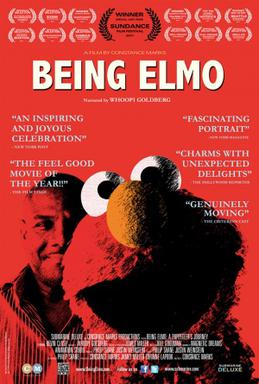
Paragraph Movie Reviews: Being Elmo
What makes a great documentary? I found this story of Kevin Clash's rise from his childhood dream of becoming a puppeteer to becoming the man who brings Elmo to life and all the steps in between to be captivating, heartwarming and inspirational. Clash is an intensely likable and interesting subject who speaks passionately and with great recall about his life and the adventures he's had throughout. The amount of archival footage that director Constance Marks was able to acquire dating back to Clash's high school days and detailing every step along the way from local Baltimore cable to Captain Kangaroo to Sesame Street is impressive and just cool (Clash either didn't believe what was happening and wanted to document everything, knew a documentary would someday be made of his life, or maybe a little of both with the amount of stuff he taped). The supplemental interviews from Clash's parents as well as figures like Frank Oz and other legendary members of Jim Henson's team were great; nothing felt tossed out. And of course the highlight (at least for me) was getting a behind the scenes look at how the Henson operation runs, be it through old test footage from a commercial Clash did with Henson and Oz to Clash helping train the staff of France's Sesame Street; it's fascinating to see what goes into these productions. I also loved watching the growth of Clash's relationships with grandfatherly Sesame Street designer Kermit Love as well as with Jim Henson himself, the stories of which I thought were supplemented in a neat way by the use of old photos and motion animation to fill in the gaps of what wasn't videotaped. Going back to the question I posed at the start of this review, though, does a documentary need some sort of tragic angle or obstacles the protagonists overcomes in order to be great? The bulk of Being Elmo tells me it does not, as most of the piece focuses solely on the positive aspects of Clash's life and career, and that worked just fine for me. There are a few spots, though, where Clash's strained relationships with his ex-wife and daughter come into play, and they just don't match up with the rest of the through line for me. There seems like there's a whole other documentary to be made about things like Clash's ex-wife telling him not to treat their daughter like a puppet or his regret over spending time making other children happy while not seeing his own; it's sad stuff and a provoking commentary on how people who never fully grow out of their childhood have difficulties with adult relationships and being parents. However, this portion of the documentary is dropped in somewhat haphazardly--his marriage is not mentioned until Clash talks about his daughter, and he already there refers to his spouse as his ex-wife--both souring your mood in the midst of this feel good tale and also raising questions that don't get fully explored. It feels like the filmmakers felt like they couldn't fully ignore this aspect of Clash, but also didn't want to give it more than minimal space; it's a 15-minute section you get the sense they felt obligated to put together rather than wanting to. However, warts and all, Being Elmo I would argue is indeed a great documentary and I'd highly recommend it.
Labels:
muppets,
paragraph movie reviews
Sunday, March 4, 2012
Paragraph Movie Reviews: Wanderlust
As a longtime fan, I'm impressed and pleased to see David Wain and others from the State/Wet Hot American Summer/Stella comedy cabal deliver a movie like Wanderlust that is their most mainstream and casual viewer-friendly effort yet without losing any of the feel (or indeed the in-jokes) of their previous work (Role Models probably exceeds it in terms of broad audience appeal, but it also loses a lot of the more quirky aspects in the process). The premise has Paul Rudd and Jennifer Aniston as George and Linda, a married New York City couple who lose their jobs and home and end up settling into a sort of hippie commune called Elysium as they try to get back on their feet and find their way; the set up provides a great gallery of weirdo characters as well as fundamental questions about discovering your path in life and prioritizing work, love and happiness (no lie, man, it's all there). As always, Rudd is game to be the heart of the story, kicking ass across the board, be it with physical comedy, improv bits in front of a mirror (seriously, these are downright uncomfortably funny), anchoring the dramatic end of the movie, etc.; he gets to go versatile as well, vacillating between the carefree and uptight half of the couple. Aniston puts in the effort and doesn't deliver a bad performance, but in all honesty, there's an exhaustion in her face and demeanor that undermines Linda supposedly being the dreamer of the two; she's not awful, but I don't buy her in the role. The greatest strength of Wanderlust, not unlike Wet Hot, comes from a deep bench ensemble, where the first half hour is essentially one great introduction after another, and the remainder is a well-balanced team effort. Justin Theroux is the standout as Seth, the charismatic alpha male of Elysium, getting under your skin with his passive aggressive attempts to undermine George and Linda's relationship even as he cracks you up rattling off outdated technology as the evils of the world or dance fighting a car; he's the kind of dimwitted douchebag Theroux himself has said he loves to play. The other principal scene stealers are Kathryn Hahn (who knows how to explode in bursts without pushing her co-stars out of the action, something Kerri Kennery could learn, I'm sorry to say), Ken Marino (completely over-the-top as George's cro-magnon successful older brother), Michaela Watkins (Marino's drugged out and long-suffering wife) and Jordan Peele (casual beyond belief Rodney). That's just scratching the surface, as Lauren Ambrose and Joe Lo Truglio are great as well, Alan Alda gets what he can out of limited material, and Malin Akerman is mostly there to be pretty, but has a funny line or two. Unfortunately, the weakness of Wanderlust is that Wain and Marino (the co-writers) are fantastic at crafting comedic bits and creating an environment for their actors to play in, but I think they still have trouble generating adversity and conflict for a more traditional movie like this. In Wet Hot, the "threat" that needs to be overcome is a falling meteor; when it comes to something more grounded like saving a marriage and having two adults come to terms with needing to give and take on their values, these guys haven't quite mastered it, so that middle portion of the movie slows down considerably. From an acting standpoint, Wanderlust is absolutely fantastic; from a writing and structural perspective, it's a great step, but still a work in progress. I laughed out loud for about 85 of the 100 minutes I was there, though, so in my mind, call it a win.
Labels:
paragraph movie reviews,
the state
Sunday, February 26, 2012
Academy Award-Winning Paragraph Movie Review: The Artist
From just about every technical standpoint, The Artist is a masterpiece; really it has to be, as it needs to hold the attention of a 21st century audience with the film making techniques of nearly a century ago and absent of any spoken dialogue or color. A great, consistently moving score help to keep you engaged with a plot that could easily lose you otherwise. Meticulous cinematography and art direction contribute as well. Michel Hazanavicius and his crew deserve tremendous credit for putting every aspect of a movie that might get glossed over because they're covered by strong acting under the microscope and making sure to get as close to perfection with them as they can. Even stuff I wouldn't normally notice like the snappy costumes stood out. And the performances are there to boot, as Jean Dujardin brims with the charm of a born leading man whose expressive physical work, comedic chops and ability to pour his heart into his face is remarkable. Berenice Bejo is a notch or two below Dujardin, but that doesn't mean she's not fantastic (she is). The supporting cast is wisely packed with actors not out of place in the setting who do so much storytelling with the way they move, particularly John Goodman, but also Missi Pyle and even James Cromwell; Penelope Ann Miller is a bit of a weak link, but she's not a particularly important cog. Finally the story being conveyed--the fall of a lovable but vain silent film star railing against talking pictures and his love story with the woman symbolizing his replacement--is strong with much to say. My big knock against The Artist would be its lack of staying power, meaning now that I've seen all the tricks (and there were some great ones, from everything I outlined to the gradual introduction of sound and so on), I really have no desire to watch it again. I'm also not sure how much my attention would have been held had I seen it in the theater as opposed to with my friends at their apartment, with us able to commentate over the whole thing (which we did). But hey, there are far worse things that being a darn near flawless piece of cinema that you only want to see once, and that dog was adorable.
Labels:
awards season,
paragraph movie reviews
Monday, February 20, 2012
Paragraph Movie Reviews: Like Crazy
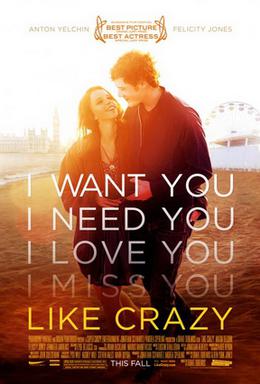
I'm a sucker for romantic movies that tug at the heartstrings, and this was quite a good one (in fact it may have tugged a bit too hard, which is a commentary on my teenage girl-like emotional over-sensitivity and if anything another compliment to the film). Anton Yelchin and Felicity Jones could not be more perfect as Jacob and Anna, an American man and British woman who meet in their final year of college and embark on a relationship that is almost immediately sidetracked by issues of distance. They hit the nice moments so well, and you become emotionally invested in their happiness almost instantly, but they're also disturbingly skilled at making their fights remarkably believable for two real people in love; their relationship never feels scripted or rehearsed, which makes the highs higher and the lows heartbreaking (I was agonizing the whole time about how one seemingly simple transgression they make with loving intentions in the first 20 minutes becomes the dragon they must battle for the remaining hour plus). They're backed up by a solid supporting cast where Oliver Muirhead and Alex Kingston shine as Anna's parents while Jennifer Lawrence doesn't do much but look pretty and Finola Hughes seems a bit wasted as well in a cameo. The film is beautifully shot, with director Drake Doremus (whose relationship with his ex-wife the story is apparently based on) specializing in wonderful close-ups and jump cuts. The time lines jumps around quite a bit, which is nice as it helps advance the plot and the characters' relationship, but can also be slightly confusing and make it seem as though you're missing key bits; fortunately Yelchin and Jones ensure that while some tipping points in their journey take place between scenes, the emotional resonance is never lost. I doubt this will go down as an all-time classic and certainly it's the type of movie I'm appreciating a lot while still in the moment of having experienced it, but even stepping back I'm really impressed by the nice little piece these folks have created.
Labels:
paragraph movie reviews
Tuesday, February 14, 2012
Paragraph Movie Reviews: Midnight in Paris
I'm not a guy who goes in for movies that are love letters to "insert city her," so I needed more from this one than pretty shots of Paris filling montages that go on a bit too long for my liking. I do like the particularity of Woody Allen's experienced-shooting style (which is still especially unique to me as I've only seen one other of his films), but again, not enough. The premise of a modern day romantic making his way back to 1920's Paris is a neat one, and novel because it brings about some excellent supporting performances in actors portraying real historical figures. Corey Stoll captures the screen with his intense Ernest Hemingway, Kathy Bates strikes a nice run-on sentence of a performance of Gertrude Stein, Adrien Brody has a fun cameo as Salvador Dali and I wanted to see more of Tom Hiddleston and Alison Pill's charming Fitzgeralds. The overall commentary Allen is making about everybody's romanticized past golden age being somebody else's dull present is one with mileage. Unfortunately all this stumbles for me with Owen Wilson's leading man performance, which starts awkward and only gets worse. I don't fault Wilson for playing out of his depth given that he's a man from the 21st century hobnobbing with his idols a century prior, but he goes too far with it and wrecks the flow of the piece for me. He has nice comedic bursts, his obvious strength, but a more meaningful dramatic performance is sacrificed and lacking. The most disappointing thing for me is how Wilson's googly-eyed rambling cuts so much of the cast's potential off because it kills the give and take. Rachel McAdams and Mimi Kennedy are brilliantly bitchy as the shallow fiancee and her loathsome mother, but Wilson fails to give his character, Gil, enough likability for me to really root against them. On the other side of the coin, Marion Cotillard is beguiling as the object of Gil's affection in the past, but the fact that she prefers this bumbler to the charismatic Hemingway when he displays no real affable qualities takes away from her credibility. It's rare that I like so much about a movie from its writing to its technical aspects to the general high quality of the performances and yet one actor can really spoil it for me, but Midnight in Paris is that unique exception.
Labels:
awards season,
paragraph movie reviews
Saturday, February 4, 2012
Paragraph Movie Reviews: The Girl With the Dragon Tattoo
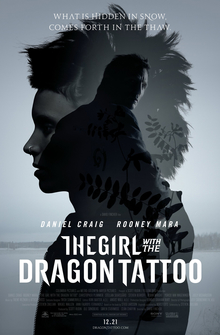
I was in a different (though I'm sure hardly unique) position with this film, having read the book pretty recently and having the story fresh in my mind. Had that not been the case, I question how easily I would have been able to follow the dense mythology, as my wife had to ask me questions throughout and I was shocked at how quickly they glossed over some points that seemed so key to the novel. To be fair to David Fincher, Steven Zaillian and company, 700 pages of incredibly dense story is a lot to cram into even a two and a half hour frame, so obviously the cuts were both necessary and no doubt challenging. To their credit, I believe they do a great job maintaining the central mystery, which is at the heart of everything, and it plays out every bit as suspenseful and thrilling on screen as in the book, despite some judiciously subtracted elements. Where I do think the translation suffers is in building the characters, Mikael more so than Lisbeth, as so much of his background established in the early parts of the book is jettisoned (again, understandably to a degree) for time here and he becomes more of a pivot to get events moving rather than a fully realized player. Despite that, Daniel Craig does an excellent job bringing James Bond charm to the role, but also knowing when to pull back and make the character more human and vulnerable. Christopher Plummer is also standout as Henrik Vanger and anchors the slow-going first half hour or so with his tortured whimsy. Likewise Stellan Skarsgard is perfectly cast in a part that required tremendous duality. Rooney Mara is, however, the breakout star as advertised, earning that Academy Award nomination with her intense and complete transformation into Lisbeth Salander, keeping that intense rage under an eerie veneer of calm until just the right moments and exploding with unforgettable bursts. The chemistry between Craig and Mara is also remarkably entertaining. It's a Fincher film, so it's beautifully shot, and Trent Reznor handles the music wonderfully. With all the changes made already, I perhaps would have altered the way the ending unfolds, as it remains anticlimactic here as it did in the book. My primary criticism beyond the overall struggle to maintain the clarity of the plot and flesh out the characters would be that the first and last half hours don't match up to the quality of the middle portion, but again, this mirrors the book as well. Great performances, well-filmed, well-scored, but also a case where the filmmakers' eyes may have been a bit bigger than their stomachs.
Labels:
awards season,
paragraph movie reviews
Friday, January 13, 2012
Paragraph Movie Reviews: Friends With Benefits
Just not good. The plot was lame romantic comedy fodder--two friends decide to "just have sex" but fall for each an hour and a half or so later--but not irredeemable with a better script, which this did not have. Almost every line spoken by either of the main characters was some sort of sarcastic snark to the point where I was just angry at them. Justin Timberlake and Mila Kunis are among the most likable performers I can think of, but in this film their characters of Dylan and Jamie are just irritating. It doesn't help that both leads seem completely unmotivated for the most part and deliver said crappy lines as if they're reading off cue cards. There are rare moments when they pick up a gag and make it work that had me mourning for the potential of this pairing if both were performing at 100%, but a lot more where I just wanted them to go away. The highlights are the supporting turns from Patricia Clarkson as Jamie's hippie mom and Woody Harrelson as Dylan's freewheeling gay buddy plus a great cameo from Emma Stone having more fun than anybody else in the cast, but Richard Jenkins, Jenna Elfman and others who should be better just whiff. With this cast, even a flimsy premise should have potential, but they came off as if the script had beaten down any enthusiasm they might have had, and less then 10 minutes in I felt the same way.
Labels:
paragraph movie reviews
Sunday, January 8, 2012
Paragraph Movie Reviews: The Help
In the wrong hands, The Help could have been a very bad movie. The script (adapted from a novel) is chalk full of moments that could have been sappy or overwrought, and in the pursuit of an accurate depiction of racism in 1960's Mississippi, there are times they skirt being too on the nose. However, it's a testament to the great work done by director and crew plus the wonderful, wonderful acting that for the most part, the film avoids those pitfalls, and even when they don't, you're enjoying it too much to notice. Octavia Spencer stands out as Minny, working sass and vigor into not just into her lighter moments but the ones where she was projecting rage; I didn't just appreciate her performance, she made me really like Minny. Viola Davis does a perfect counterpoint to Spencer, with Aibileen as the quiet and restrained half of their duo whose probably explosion of emotion has you anticipating intensely; Davis has a pronounced dignity about her that was perfect here. Bryce Dallas Howard has never been better than here as Hilly, creating a villain whose misfortunes you can laugh at without her stature and hatefulness ever being diminished. Jessica Chastain had me laughing out loud as naive Celia, the redneck girl who marries into wealth, but she also provided some of the most powerful scenes. I'd actually say the only person who fell a little short for me was Emma Stone, which is surprising; Stone is always great, and very versatile, but I felt like she played Skeeter's quirkiness for laughs maybe a few too many times and that upset the flow of the narrative slightly. So many other great performances though, from Allison Janney to Cicely Tyson to Sissy Spacek and on; even the little girl who played Mae Mobley was fantastic. A real joy to watch--and given the subject matter, that feels strange to say, but it's how I feel--The Help lives up to the hype.
Labels:
paragraph movie reviews
Saturday, December 31, 2011
New Year's Eve Paragraph Movie Review: Warrior
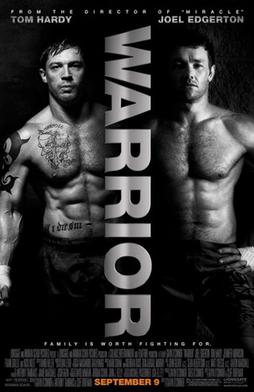
Warrior is a good sports movie that missteps by trying to overreach and become a great film. It doesn't reinvent the wheel, mainly sticking to the Rocky formula underdog story in the beginning, but I like that formula, so I had high hopes. Indeed the basic building of the characters is solid and the fight scenes are superb; it's where they try to force in the family drama of The Fighter or the redemption story of The Wrestler that I think Warrior falters because it's just trying too hard. There is too much juxtaposing of hokey-but-fun sequences right alongside scenes that are supposed to be deadly serious; the former works for the most part, the latter doesn't always. The cast is good for the most part, but the script sticks them on a treadmill a lot of the time. Most of the attention in reviews went to Tom Hardy, who is indeed impressive with his committed habitation of his character, an intense cipher whom he makes terrifying and intriguing, and he clearly worked his ass off to get physically set for the role, but he's stuck playing out the same pissed off speech way too many times. I don't think the continually unraveling layers of mystery of Tommy's military past fit either. I found Joel Edgerton's performance as the underdog family man far more compelling and his story the one I wanted to follow; his scenes with the Conlon brothers' reformed scumbag father--Nick Nolte, doing nice work with what he's given--are probably the best in the movie. Frank Grillo was a standout in a supporting cast of quality character actors as Brendan's quirky but intelligent coach; Jennifer Morrison is a beautiful girl with some talent, but she makes me cringe with her facial expressions and emoting. Bottom line is that there's a good movie buried in Warrior that probably could have been told in about half the time; I'd have liked to have seen them accentuate the positives and go more Rocky IV than Rocky (or The Fighter), making a fun, memorable movie instead of one begging for critical acceptance. I wanted to see more fighting, less family drama. Also, the ending was pretty lousy.
Labels:
paragraph movie reviews
Sunday, October 23, 2011
Paragraph Movie Reviews: Footloose (2011)
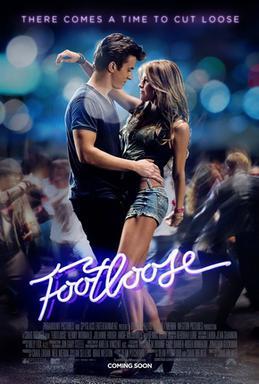
Hey, no fooling, this is quite a good movie! It's not anything heavy, it will unlikely be an all-time classic, but it's fun and accomplishes that rare remake feat of paying tribute to and respecting the original work while distinguishing itself and even improving in some areas in a way that doesn't come off heavy handed. The primary strength of Footloose v2.0 is that Kenny Wormald and Julianne Hough as Ren and Ariel have enough swagger and charisma to light up a small city (if technology allowed such a thing). Their chemistry is great; it may even surpass that of Kevin Bacon and Lori Singer from the original. I'd definitely argue that Hough tops Singer on her own as Ariel, approaching the character and her inner turmoil with superior ease, making the 2011 incarnation more believable and multi-dimensional than her 1984 counterpart. It's not really fair to stack Wormald against Bacon in one of the latter's signature roles, but the newcomer does fine in just about every respect (his angry dance, while technically excellent, falls short of the original, but that's near cinematic perfection), bringing where needed an even rougher edge to Ren that brings him into the 21st century nicely. It is a little tougher, admittedly, to accept the whole "kids died in a car accident clearly because of alcohol so we're going to ban dancing" premise without the benefit of being able to wave it off as 80's foolishness, and attempts to justify it don't hold up too well, but they make up for that by including scenes to flesh out the characters and their relationships I wish were in the original, most notably the pre-prom pow wow between Ren and Reverend Moore. Unfortunately, the one performer I'd say fell a bit flat was Dennis Quaid as Moore; John Lithgow was one of the pillars of the first film, bringing an ambiguity and conflict to Moore that Quaid can't seem to latch onto, instead just settling into brow-furrowed concern and disapproval. The rest of the supporting cast is top notch though, from Miles Teller admirably filling the late Chris Penn's comic relief shoes as Willard to Ray McKinnon stepping up as Ren's uncle in a role greatly expanded from the original to provide a father figure who fits in nicely. Indeed this movie seemed to excel at knowing when to follow its predecessor line-for-line, when to veer off to the extreme, and when to toss a wink but then still do something different; kudos to Craig Brewerfor treading that line. One more weakness I'd chalk up would be that pretty much every cover of a song from the original was inferior, but Wormald, Hough and company make up for that by bringing the intensity when it's time to dance. I'd be curious how somebody who has never seen the first Footloose would come to this movie, as I clearly spent a lot of time comparing the two, but obviously I dug it.
Labels:
paragraph movie reviews
Saturday, October 8, 2011
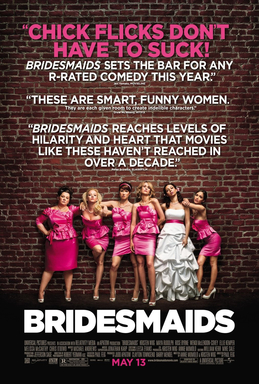
Paragraph Movie Reviews: Bridesmaids
Thoroughly underwhelming. The way this movie was hyped, I was expecting to be busting a gut laughing for over two hours, but instead it was an ok flick with a few standout bits performances but a disjointed flow and fumbles on the emotional payoffs. I don't overly fault Kristen Wiig the performer, as she was funnier and displayed more dimension here than she has in several years on Saturday Night Live, but she still seemed to panic and fall into her stock characters more than I would have liked. I do blame Wiig the co-writer as the story lurches without a through line essentially from skit to skit as--to be fair--most of this genre of comedy does nowadays, but the success ratio of said bits isn't strong enough to justify it. The airplane sequence, for instance, is hysterical, but the dress scene is cheap gross out humor (and no, I would not have liked it if it was dudes; I never dig that stuff personally) and I couldn't name you much else from memory. The rivalry between Wiig and Rose Byrne wears thin really quickly and drags the plot down around it while Wiig's friendship with Maya Rudolph, the other big emotional centerpiece, is uneven, blowing up and repairing without much rhyme or reason. However, there's still a lot to like about Bridesmaids, in large part from the well-cast supporting players. Melissa McCarthy is the best part of the movie, the only thing that lived up to the hype for me, throwing herself into her role completely and making you wish she got more screen time. Chris O'Dowd totally won me over after a slow start and his courtship with Wiig is the truest thing about the entire movie. Jon Hamm proved once again he is hilarious, while bit players Rebel Wilson and Matt Lucas stole every scene they were in. But the most pleasant surprise? The late Jill Clayburgh turning in a quietly funny and heartfelt performance as Wiig's mother in what I believe was her final role. So yeah, if you watch the highlight reel, Bridesmaids isn't bad, but as long as it runs, there's way too much dead air and "huh?" moments for it to come anywhere close to being the comedy it was sold to me as.
Labels:
paragraph movie reviews
Saturday, September 24, 2011
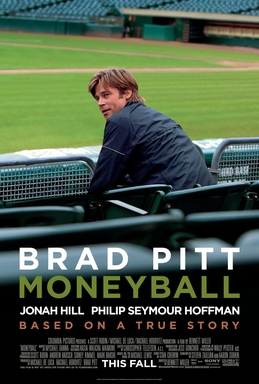
Paragraph Movie Reviews: Moneyball
I wanted this movie to be better. It was good, make no mistake, but I thought it could have been great. Brad Pitt is commanding as Billy Beane and turns in what will likely and should be an award-garnering performance full of intensity, charisma and depth. I wasn't so much sold on Jonah Hill and that hurt the film a great deal for me. I give Hill credit for trying to rein in his usual comedic delivery, but I felt like even toned down most of his line readings came off unintentionally awkward and funny, which took me out of the moment more than once; Peter Brand is not supposed to be the comic relief here, he's supposed to be a key part of the story's nucleus, and I was unable to take him seriously. The story was engaging and the script was good, but the pacing jumped around. I liked the juxtaposition of Beane's younger years with his current struggles, but they failed to keep a consistency of how they balanced the two, giving the former a lot of real estate in the first half of the movie and then dropping it suddenly about halfway in only to pull back to it at very random times. There were scenes that were absolutely brilliant--any time Beane is orchestrating trades or dealing with his scouts is, pardon the pun, money--but the glue between them was shaky. The transitions between acts didn't hold up for me; the acts themselves taken alone were very good, but it felt like they were missing a lot of build and just jumping from one key point to the next. The climax to the film was pretty unforgivably over-dramatized; I understand and appreciate the need for theatrics in sports movies (I love Rocky), but the way they frame Beane supposedly jinxing the A's winning their 20th straight was hokey to the max. Chris Pratt was surprisingly good in the sense that he swapped out just enough of his comedic tendencies in a way I wish Hill could have. Philip Seymour Hoffman is a non-factor. I'll still rank this movie highly and recommend it based off things like Pitt's terrific performance, the tight script, solid directing and that the good scenes are really, really good, but it's missing too much in the connective tissue to achieve its full potential as an all-time classic.
Labels:
paragraph movie reviews,
sports
Saturday, September 17, 2011
Paragraph Movie Reviews: The King's Speech
With technical brilliance and tour de force acting, The King's Speech in my estimation lived up to the hype even being an Academy Award for Best Picture brings with it. From the first measured shots of microphones through every pan and close-up, I was fully taken in by how Tom Hooper chose to frame his work and the visual calculation with which it was pulled off. Every set, costume and sound effect worked in the harmony you hope for from every movie. But even with all those aspects handled so expertly, it was in the performances that a story ostensibly of a man learning to control a stutter--surrounded though it was by political intrigue and the most explosive conflict of our times--became an engaging, tense, funny and riveting ride. The "action" scenes were montages of speech exercises or slow frames of a man taking to a microphone, but I felt as though I was watching Rocky for how invested I was. Colin Firth's King George is one of the finest performances I have seen in some time, capturing a complex figure who is at once a tortured outcast, an explosive child, a pitiable victim, a witty gent, a warm family man, and ultimately a good king. Firth plays every aspect expertly, with vigor, and shifts between them without a hitch; I felt awful for him, I felt anxious with him, I laughed at him and I rooted for him. Geoffrey Rush holds up his end of the central dynamic with equally adept skill, balancing the quirkiness of Lionel Logue with a brashness and confidence that never makes him seem the bad guy, but does give him sufficient edge; the chemistry between Firth and Rush is undeniable. It was a joy to see Helene Bonham Carter play against type (at least so far as the roles I've seen her in), coming off charming and whimsical as Elizabeth. Michael Gambon and Guy Pearce were nice casting coups as stoic George V and carousing Edward VIII while Timothy Spall demonstrated his usual chameleon skill in mimicking Winston Churchill. If I were to bring some criticism against the film it would be that the ebb and flow of Bertie and Lionel's relationship does get a bit extreme at times, their friendship swelling and dissipating alternately to a degree I didn't think was justified by what was taking place onscreen and could only be ascribed to holes in the narrative, but Firth and Rush were so spot on in conveying the evolution in their performances it's easily forgiven. The last ten minutes of a guy simply delivering a speech were as compelling and intense as any climax I've seen in recent years; this one earned its accolades.
Labels:
awards season,
paragraph movie reviews
Saturday, September 10, 2011
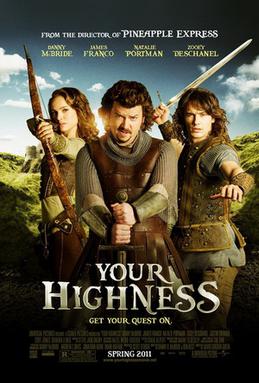
Paragraph Movie Reviews: Your Highness
I was highly anticipating this movie from the trailers and talent involved when it came out in theaters, but then never managed to see it and it didn't make much of a splash so I forgot about it. I'm glad I decided to check it out at home, because this was a very solid, very funny effort that distinguishes itself from the ever burgeoning genre of (let's call them) vulgar stoner comedies quite nicely. The primary strength of the film is the contrast between Danny McBride's enthused ridiculousness in the face of the setting to James Franco's earnest embrace of his straight man role as it's a microcosm of everything that works. This isn't a full-on send-up of the swords and sorcery genre in the way, say, Robin Hood: Men in Tights or things along those lines were, but in many ways a medieval adventure story that's 60% serious and well-crafted as such so that it's more funny the way the comedic aspects stick out. Because the technical aspects of the film are so well done from the sets to the effects to the battle sequences, the casual crudity of the lines coming out of McBride's mouth in his ridiculous accent make you laugh more, and when Franco occasionally breaks from his decrees of nobility or lovelorn poetry to swear, it's even better. Having Natalie Portman take her role absolutely serious in the midst of the absurdity is perfect, as is having Charles Dance essentially playing Tywin Lannister with not a hint of irony. Justin Theroux hems and haws a bit in his role as a creepy and sexually repressed sorcerer, but he hits more than he misses; if anybody is underutilized, it's Zooey Deschanel, if only because they set up a nice recurring gag with her early on and then drop it after a few scenes. I would say that even at under two hours this isn't a long movie, but too long for this particular premise by just a little bit. It's not just a funny movie, though, it's a movie that's comedy is clever and calculated, despite being mostly sex jokes and curse words, and achievement in and of itself.
Labels:
paragraph movie reviews
Sunday, September 4, 2011
Paragraph Movie Reviews: Shark Night 3D
This one is a bit tough for me to assess since I'm not really a horror/schlock fest connoisseur, but I'll do my best. It's a solidly entertaining movie that delivers on what is advertised: An over-the-top carnival of flesh, gore and special effects with plenty of sharks. It's actually a decent cast of young actors, many of whom I've seen deliver in meatier roles, who move the bare bones plot along fine but don't quite give us a reason to care as they're getting slaughtered. The story is minimal, but it gets the job done; I guessed some of the big plot twist, but not all of it, so kudos there. The FX aren't revolutionary, but again, they impress enough and the 3D is well-done and well-utilized; there were at least two moments where I jumped a bit and let out at least a little yell because a jumping shark freaked me out. The sharks also looked darn scary and not done on the cheap, and at the end of the day I'm wagering that what a bunch of folks want to see here. Bottom line: If you were already planning on seeing Shark Night, you'll probably dig it; if you had no plans to check it out, I wouldn't go out of your way to alter that.
Labels:
paragraph movie reviews
Saturday, September 3, 2011
Paragraph Movie Reviews: Our Idiot Brother
A tremendous waste of a pretty impressive cast. The gist is that Paul Rudd's Ned is a well-meaning simpleton who ends up homeless and thus works his way through each of his three sisters' homes and lives, unintentionally screwing up their relationships along the way, but ultimately helping them. If the premise seems a bit thin, that's because it is; it's a bad script with a predictable plot you can see coming at every turn. Despite this, the movie succeeds in spite of itself in some moments simply because Rudd makes bits that shouldn't be--and wouldn't be in the hands of another actor--funny by sheer force of will. However, considerable as it is, Paul Rudd's charm can only carry a film so far, and even he can't make up for a lame attempt to squeeze an hour and a half of missing character development into the final 15 minutes. The most frustrating part of Our Idiot Brother is, however, as mentioned, the wasted talent: Zooey Deschanel is miscast and barely used, Elizabeth Banks is forced into being the uptight sister when she works much better playing carefree or least wild, and Emily Mortimer spends more time attempting to mask her British accent than putting on a decent performance. Adam Scott shows flashes of potential as Banks' love interest, so he gets cut from most of the movie, Steve Coogan pushes the dial too far past loathsome as Mortimer's adulterous husband and Rashida Jones is uneven as Deschanel's lawyer girlfriend. The funniest and best-used supporting players are Kathryn Hahn as Rudd's passive agressive hippie ex, T.J. Miller as her clueless new stoner beau and Sterling K. Brown as an incredulous parole officer. I'd love to see this same cast in a better movie.
Labels:
paragraph movie reviews
Saturday, August 27, 2011
Paragraph Movie Reviews: Footloose
I just watched this for the first time in 2011, so it's hard to judge it on merit and not get swayed by a mix of nostalgia and skepticism at the 80's trappings, but I felt like the stuff that was important is pretty timeless. Kevin Bacon was still poured perfectly into the role with boatloads of charisma, a ton of physical skill and the right combination of smooth cockiness with awkward nerves. John Lithgow's performance as a haunted and conflicted would-be-antagonist holds up. Chris Penn is hilarious and the most underrated part of the movie for me. The montages are pitch perfect in a way that captures the feel they were going for and revs you up. I even dig Sarah Jessica Parker in the spunky sidekick role and thought Lori Singer was solid if uneven while Dianne Wiest did a lot with what little she was given. And of course the dancing is phenomenal, as is the music. The story is a bit frustrating with so much I wish I could have actually seen taking place between scenes, most significantly Ren asking Reverend Moore if he can take Ariel to the prom and talking about their family lives, which seems like a pretty crucial moment you'd want to keep off the cutting room floor and one of the few chances to get Bacon and Lithgow on screen together one on one; but also I would have liked more just of Ren adjusting to high school and interacting with the other students (I had no idea he was one the gymnastics team at all and would have liked to actually see the plan for the dance come together or the council's verdict). I wasn't really watching Footloose for a tight plot, though; I wanted a series of feel good, kick ass highlights I can watch later on fast forward, and I got that with a movie that had everything I love about 80's formula teen movies.
Labels:
paragraph movie reviews
Tuesday, August 23, 2011
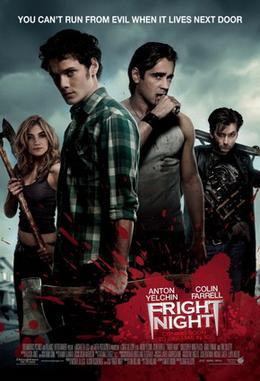
Paragraph Movie Reviews: Fright Night
This is not a "good" movie in the sense that the pacing is funky, the dialogue is often crap and the 3-D is completely tacked on; a film student would probably have a heart attack after watching this. Is that of any relevance as far as its entertainment value? Not as far as I'm concerned. I had a helluva lot of fun watching this, and not just in a "so bad it's good" way. Here's an instance where clearly the director and particularly the actors saw they had a pretty hokey script--perhaps intentionally so--and rather than try to make it anything but that, just went to town and had fun. Watching Colin Farrell was a delight; the same as when he played Bullseye in Daredevil, as the vampire Jerry he just enjoys the heck out of not just every line he delivers, but every millisecond he has to mug for the camera with a twitch or smile or goofy face. Farrell knows the perfect line between campy and cool and it's a joy to watch the man work. While he can't touch Farrell--nobody could have--David Tennant is pretty great in his own right as a Criss Angel parody with a dumb secret origin that, again, works because they don't take it too seriously. Christopher Mintz-Plasse plays the same character he always plays and has limited screen time, but if it ain't broke, don't fix it. Anton Yelchin has the unenviable task of being the comparably square hero between the twin towers of Farrell and Tennant, but he brings some to the role, and even goes for a little pathos on occasion. I'm not sure exactly what Fright Night was meant to be, a full-on horror comedy or a traditional horror movie; it wasn't that scary, but it was hilarious and fun, so I hope the goal was the former. It has slow moments, there are some points where the plot is too bad to even laugh at and, again, the 3-D was absurdly gratuitous, so I can't give it quite top marks, but for the most part it was pretty enjoyable and even occasionally clever, so I tend toward thumbs up. If you're expecting the next great horror movie, skip this, but if you want a fun diversion under two hours, I think you'll be pleased with this.
Labels:
paragraph movie reviews
Saturday, August 6, 2011
Paragraph Movie Reviews: Conan O'Brien Can't Stop
At first despite being very pumped to watch this, I wasn't sure I'd enjoy it, because it starts slow. I don't think Rodman Flender worked that hard at creating a compelling narrative or pacing the story, so as a result, the establishing of the situation and initial planning stages drone on and fall a bit flat. Fortunately, Conan O'Brien is a compelling and entertaining enough subject that ultimately the quality or lack thereof of the technical storytelling doesn't matter; you're drawn in by O'Brien himself, want to get to know him and his story, and he doesn't disappoint. As a result, Flender really just has to be competent at following O'Brien around with cameras and knowing how to cut a movie--he is proficient in both--and his subject handles the rest. Once O'Brien is out on the road performing and his testimonials begin to reveal more about his psyche, this becomes a very good piece. O'Brien is a fascinating individual, balanced between his love of performing for crowds and intense scrutiny over his work. It's hard to tell how much of his inability to stop (as alluded to in the title) and desire to interact with his public is fueled by work ethic and how much by a sort of addiction. While Flender certainly presents O'Brien in a flattering light that seems genuine, he doesn't lionize him to the point of not showing the more personal moments where he is frustrated by having to meet and greet all his back-up singer's family and friends, an act he seemed completely enthused by in the previous scene. The footage of the actual shows is fun, but I didn't so much care for seeing how the sausage was made in this case; I was far more engaged by Conan himself, his relationships with the people around him--particularly with his young assistant, as they had a natural comic chemistry and she was tremendously endearing--and the rewards as well as the toll this experience handed him. While the stuff with Jack McBrayer is hilarious, the shots of Conan exhausted and alone following a performance are what will stick with me.
Labels:
paragraph movie reviews,
tv